

5S in simple words
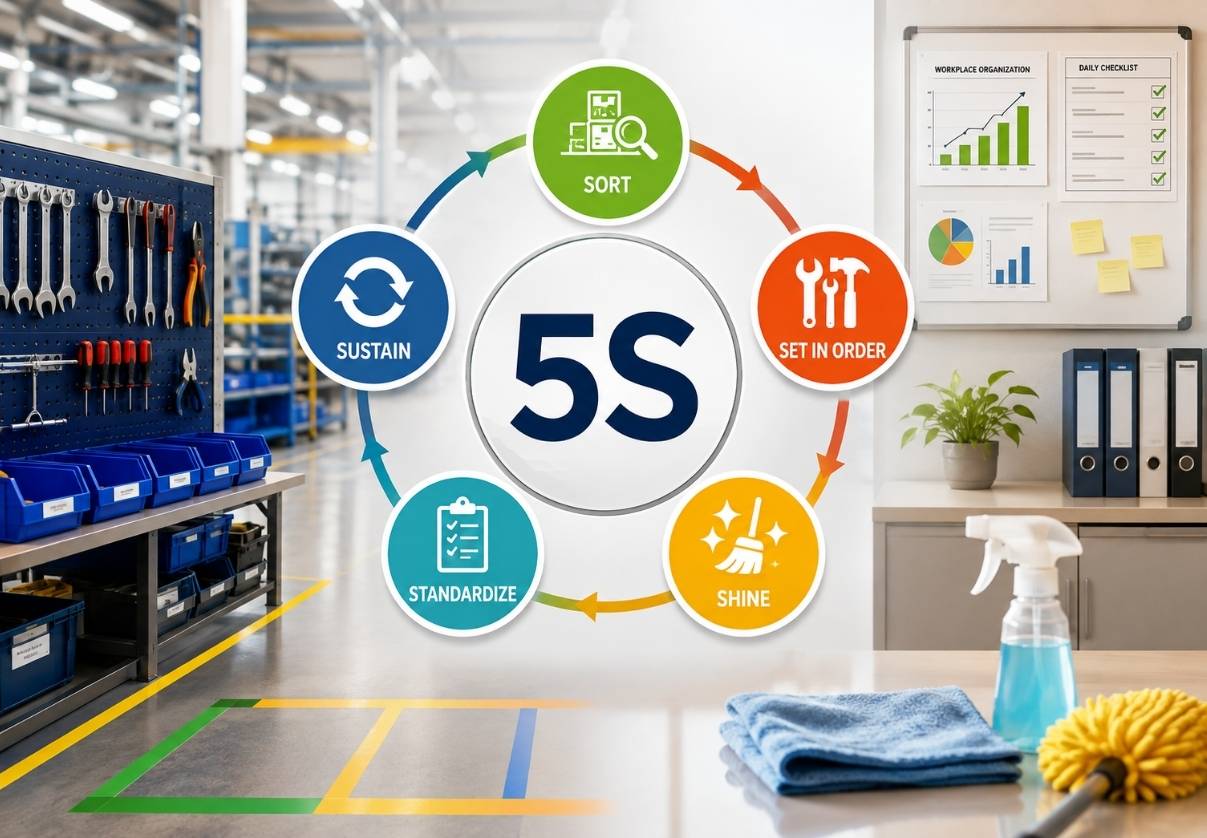
5S is a simple method to keep the factory clean, organized and easy to manage.
It has five steps:
5S can be used in textile factories, garment factories, warehouses, offices and many other workplaces.
- Sort
- Sort
- Shine
- Standardize
- Sustain
A Simple Guide to Better Factory Management
| Meta Title | 5S Implementation in Textile Factories | Simple Guide | |
|---|---|---|
| Meta Description | Learn how 5S implementation can help textile factories reduce waste, save time, keep the workplace organized and improve daily work. | |
| Main SEO Keyword | 5S implementation in textile factories | |
| Other SEO Keywords | 5S implementation, 5S in textile industry, 5S in manufacturing, 5S methodology, textile factory management, textile factory productivity, workplace organization, 5S audit, Lean manufacturing | |
What is 5S?
In a textile factory, every day we see small problems.
Why is 5S Important for a Textile Factory?
A textile factory has many materials, machines, tools and people working together. When everything has a proper place and proper method, work becomes easier.
A simple rule
Don’t waste time looking for something that should already be easy to find.
1. Sort – Keep Only What Is Needed
“Do we really need this here?”
If not, remove it, repair it, return it or move it to the correct place. This creates more space and makes the workplace easier to manage.
2. Set in Order – Give Everything a Proper Place
Simple rule
“A place for everything, and everything in its place.”
When a worker can find something quickly, valuable working time is saved.
3. Shine – Keep the Workplace Clean
The third step is Shine, which means cleaning the workplace and machines regularly. But cleaning is not only about making the factory look good. While cleaning, workers can also find problems such as:
So cleaning becomes a way to find problems early. A clean workplace is easier to inspect, easier to manage and safer to work in.
4. Standardize – Make One Good Way of Working
Suppose one supervisor keeps materials in one way and another supervisor keeps them somewhere else. This creates confusion. The fourth S is about creating one standard way of working.
For example, decide:
Simple checklists, SOPs, signs and labels can help employees follow the same system every day.
“Don’t depend on memory. Create a standard.”
5. Sustain – Continue Every Day
This is the most important step.
Many factories start 5S with great enthusiasm. Everything gets cleaned. Everything gets arranged. Photos are taken. And after a few months, everything goes back to the old way.
HK Business Solutions . 5S Implementation in Textile Factories
Simple checklists, SOPs, signs and labels can help employees follow the same system every day.
“Don’t depend on memory. Create a standard.”
How to Start 5S in Your Textile Factory
You don’t have to start with the entire factory. Start with one area.
- Fabric Store
- Cutting
- Sewing
- Maintenance
- Packing
- Finished Goods
HK Business Solutions . 5S Implementation in Textile Factories
- 1. Take a look at the current situation – Find out where time and space are being wasted.
- 2. Remove unnecessary items – Do not keep things simply because “we may need them someday.”
- 3. Give everything a fixed place – Use labels, markings and proper storage.
- 4. Clean and inspect – Clean the area and identify problems.
- 5. Create simple rules – Decide who will maintain the area and how.
- 6. Check regularly – Do not wait for a customer visit or inspection. Check the area regularly.
Common Mistakes During 5S Implementation
- 1. Thinking 5S means only cleaning – Cleaning is only one part of 5S.
- 2. Doing 5S – only before an audit 5S should be followed every day.
- 3. Not involving workers – The people working on the floor know many of the daily problems. Their ideas are important.
- 4. No follow-up – If nobody checks the system, old habits quickly return.
- 5. Making the system too complicated – 5S should make work easier, not create more unnecessary paperwork.
The people working on the floor know many of the daily problems. Their ideas are important.
Can 5S Improve Textile Factory Productivity?
Yes. When implemented properly, 5S can help reduce wasted movement, searching time and workplace confusion while improving organization and daily work. Studies in textile and garment manufacturing have also linked Lean practices including 5S with improvements in areas such as workplace organization, efficiency and waste reduction.
5S is not a magic formula. Results depend on how seriously the management and employees follow the system.
5S and Technology
Today, factories can also use technology to support 5S.
Final Thoughts
5S is not about making a factory look beautiful for visitors. It is about making daily work easier.
When workers know where everything is, when machines and areas are properly maintained, and when everyone follows the same basic system, the factory becomes easier to manage.
Start small
Choose one department. Improve it properly. Make the new system a habit. Then move to the next department.
How HK Business Solutions Can Help
Implementing 5S is easier when responsibilities, SOPs, tasks and follow-ups are clearly managed. HK Business Solutions helps businesses improve their daily systems through SOPs, task management, reporting, process improvement and digital solutions.
Need help with 5S?
If you are planning 5S implementation in your textile factory and want a practical system that your team can actually follow, contact HK Business Solutions to discuss your requirements.
Frequently Asked Questions
Implementing 5S is easier when responsibilities, SOPs, tasks and follow-ups are clearly managed. HK Business Solutions helps businesses improve their daily systems through SOPs, task management, reporting, process improvement and digital solutions.
What is 5S in a textile factory?
Is 5S only for large factories?
How many steps are there in 5S?
Is 5S only about cleanliness?
How can 5S help a textile factory?
Reference Sources
Evaluating 5S Implementation and Challenges in Garment Manufacturing Units: A Study in Tiruppur District – Research Journal of Textile and Apparel, 2026
https://link.springer.com/article/10.1007/s00170-026-17713-6
Applications of Lean Manufacturing in the Textile Garments Industry – The International Journal of Advanced Manufacturing Technology, 2026
https://link.springer.com/article/10.1007/s00170-026-17713-6
Lean Manufacturing Practices in Textile Industries – A Case Study – Amrita Vishwa Vidyapeetham
https://www.amrita.edu/publication/lean-manufacturing-practices-in-textile-industries-a-case-study/